An AI creator does not need a fake childhood, fake acne journey, fake job, and fake favorite coffee shop to have personality.
That is not characterization. It is a synthetic person making implied factual claims.
Personality can come from:
- point of view;
- delivery;
- taste;
- recurring formats;
- decision rules;
- humor;
- visual identity;
- what the creator refuses to say.
Build the creator as a disclosed brand character or presenter. Do not manufacture a customer biography and hope specificity makes it believable.
Start with the creator's role
Choose one:
Brand presenter
Explains:
- product;
- workflows;
- examples;
- comparisons;
- educational material.
Can say:
"Ghostfeed turns one approved source into creator variations."
Cannot say:
"I used Ghostfeed for my company and cut CAC by 40%."
Unless a real, authorized person truthfully had that experience.
Fictional brand character
Has a clear fictional identity and can participate in stories or entertainment.
The account and context should not mislead people into believing the character is a real private individual.
Licensed digital double
Represents a real person under documented authorization.
Needs:
- likeness rights;
- voice rights;
- allowed claims;
- allowed contexts;
- approval rules;
- revocation and expiry terms.
Product guide
Demonstrates screens and actions without claiming personal experience.
The role determines what the creator can know and say.
Write truth boundaries first
This is the most important page in the persona bible.
TikTok's current AI-content rules address realistic synthetic media, likeness, and labels. The FTC's Endorsement Guides also cover virtual influencers and truthful endorsements. Review TikTok's AI-generated-content guidance and the FTC endorsement resources.
Define point of view through decisions
Weak:
Smart, funny, authentic, slightly sarcastic.
Useful:
Now the creator can react consistently to new topics.
Define voice with observable rules
This is stronger than a long invented biography.
Add approved and rejected examples
Approved:
"500 videos a day" usually counts exports, not ideas.
Why:
- concrete;
- skeptical;
- explains the hidden accounting problem.
Rejected:
You guys, I literally cried when I saw how much Ghostfeed saved my business.
Why:
- invented personal experience;
- melodrama;
- unsupported outcome;
- interchangeable influencer voice.
Add ten of each.
Models learn persona boundaries from contrast better than adjectives.
Build a visual identity system
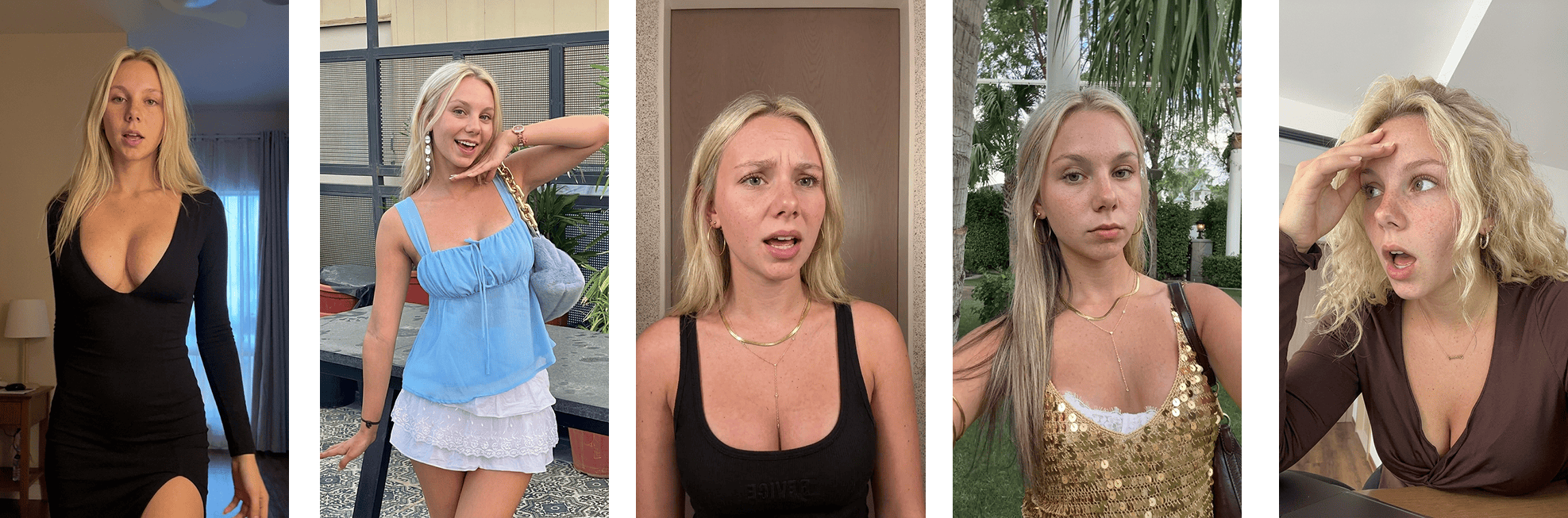 Ghostfeed creator roster
Store:
- master identity reference;
- approved angles;
- expression range;
- wardrobe system;
- recurring environments;
- camera language;
- color treatment;
- forbidden visual contexts;
- rights metadata.
Separate identity from scene.
Identity:
- face geometry;
- hair;
- skin;
- age presentation;
- distinctive details.
Scene:
- clothing;
- location;
- camera;
- lighting;
- action.
If both change on every generation, the creator becomes a new person every post.
See the difference between generating avatar options and approving one identity for repeated use.Give the creator an emotional range
Do not lock the creator into one expression.
Define:
| State | Use | Avoid |
|---|---|---|
| Skeptical | Unsupported claims, comparisons | Contempt |
| Focused | Product walkthrough | Blank stare |
| Surprised | Real evidence reveal | Maximum gasp at ordinary UI |
| Warm | Onboarding, encouragement | Fake intimacy |
| Amused | Industry absurdity | Mocking customer pain |
Then create approved source frames for each.
Different creators can express the same format without pretending to share the same life story.
Use recurring formats, not catchphrase spam
Useful recurring series:
- "The metric is lying";
- "Show me the proof";
- "What I would automate last";
- "One source, three executions";
- "Why this render failed";
- "The strongest counterargument."
Each series has:
- a question;
- a visual grammar;
- an expected payoff;
- a boundary.
A catchphrase repeated in every video becomes synthetic faster than it becomes memorable.
Give the creator knowledge boundaries
The model should cite or refuse.
A coherent personality that confidently states stale product facts is worse than a generic presenter.
Add relationship rules
Decide how the character interacts:
- replies as the brand, not as a fake customer;
- does not imply private experiences;
- does not flirt or create emotional dependency;
- does not claim to be physically present;
- does not impersonate employees;
- escalates support and sensitive questions;
- preserves disclosure in DMs where relevant.
This matters if the persona moves from video into comments or messaging.
Test persona identity
Create a blind set:
- four personas;
- five shared topics;
- one script each;
- no names.
Ask reviewers:
- Can you match the script to the persona?
- Which rule identified it?
- Did the script stay truthful?
- Did it preserve product facts?
- Did personalities collapse into one house voice?
Measure:
- persona-match accuracy;
- prohibited-claim rate;
- edit distance to approval;
- repeated phrase frequency;
- voice drift over time.
If reviewers identify a persona only from the same catchphrase, the system is shallow.
Version the bible
Every script and asset records the versions used.
When a creator drifts, you can identify whether:
- prompt changed;
- reference changed;
- model changed;
- voice rules changed;
- approval became inconsistent.
A compact persona brief
That is enough to make a creator recognizable.
The personality comes from stable choices and constraints—not a fabricated trauma arc.
Ghostfeed can reuse the approved identity across reactions, explainers, and variations. The persona bible keeps those assets connected to a truthful role.
With Ghostfeed MCP connected, an agent can operationalize that role instead of merely writing about it. It searches the workspace templates before the Ghostfeed inspiration library:
The agent can search, cast, render, and poll through MCP. A required crop, Smart Crop, final edit, and publication remain visible dashboard or human decisions.
For visual consistency, read Why AI UGC looks fake. For format selection, use Five AI UGC formats for app marketing.