One bad TikTok post is content.
Ten bad posts are a pattern.
The mistake is calling both of them a shadowban.
When views collapse, people jump straight to device fingerprints, proxies, and rebuilding the account. Sometimes the account has a real restriction. Sometimes a post is ineligible for recommendation. Sometimes the content got boring. Those are different problems and setting fire to the phone fixes none of them.
This is the diagnostic I would run on an account that was already posting and then lost reach.
For new-account setup, read the separate TikTok warmup field guide. This article starts after the account has a history.
First: stop using "shadowban" as a diagnosis
"Shadowban" usually means:
My recent posts received fewer views than I expected and TikTok did not give me a satisfying explanation.
That feeling is real. The diagnosis is not.
There are at least four different states:
- an account feature is restricted;
- the account or posts are ineligible for recommendation;
- the account is healthy but recent creative underperformed;
- the account is healthy and you are reacting to normal variance.
Start with the states TikTok can actually show you.
Check 1: TikTok's account status
TikTok has an Account check inside TikTok Studio and the Safety Center. It can show restrictions affecting login, posting, comments, profile editing, and direct messages.
TikTok's current instructions are on its account status support page.
In the app:
- Open Profile.
- Open the menu.
- Go to TikTok Studio.
- Under More tools, open Account check.
Or:
- Settings and privacy.
- Support.
- Safety Center.
- Account check.
Screenshot the result. Do not rely on somebody saying "all green" in Slack.
If there is a warning, follow the named issue and appeal path. Do not create replacement accounts to evade a restriction. TikTok's guidelines explicitly prohibit circumvention.
Check 2: recommendation eligibility
An account can still post while being harder to find.
TikTok says accounts that repeatedly post material unsuitable for the For You feed may become ineligible for recommendation. TikTok also says it notifies the account in the inbox and profile, shows the affected videos, and provides an appeal. See TikTok's recommendation eligibility guidance.
Check:
- inbox notices;
- profile notice under the username;
- post-level analytics or eligibility messages;
- the specific content TikTok identified;
- whether an appeal is available.
If TikTok names a reason, use that reason. "Geo leak" is not a better explanation than the notice sitting in the app.
Check 3: isolate when the drop began
Make a table for the last 20 posts.
| Post | Date | Format | Hook | Views | Hold or watch signal | Saves | Shares | Status notice |
|---|
Mark the first point where the distribution changed.
Then ask:
- Did the account change format?
- Did it start posting more often?
- Did every post begin using the same avatar?
- Did the product move earlier?
- Did hooks become generic?
- Did source videos start carrying watermarks?
- Did disclosure behavior change?
- Did the audience lane change?
You are looking for a change that happened before the drop, not a theory you already wanted to prove.
What a working phone-farm portfolio actually looks like
This is a snapshot from my own AI UGC phone-farm operation, not a hypothetical benchmark. It shows 19 short videos published across multiple US TikTok accounts over four days. In the same operating window, individual posts ranged from 110 views to 12K.
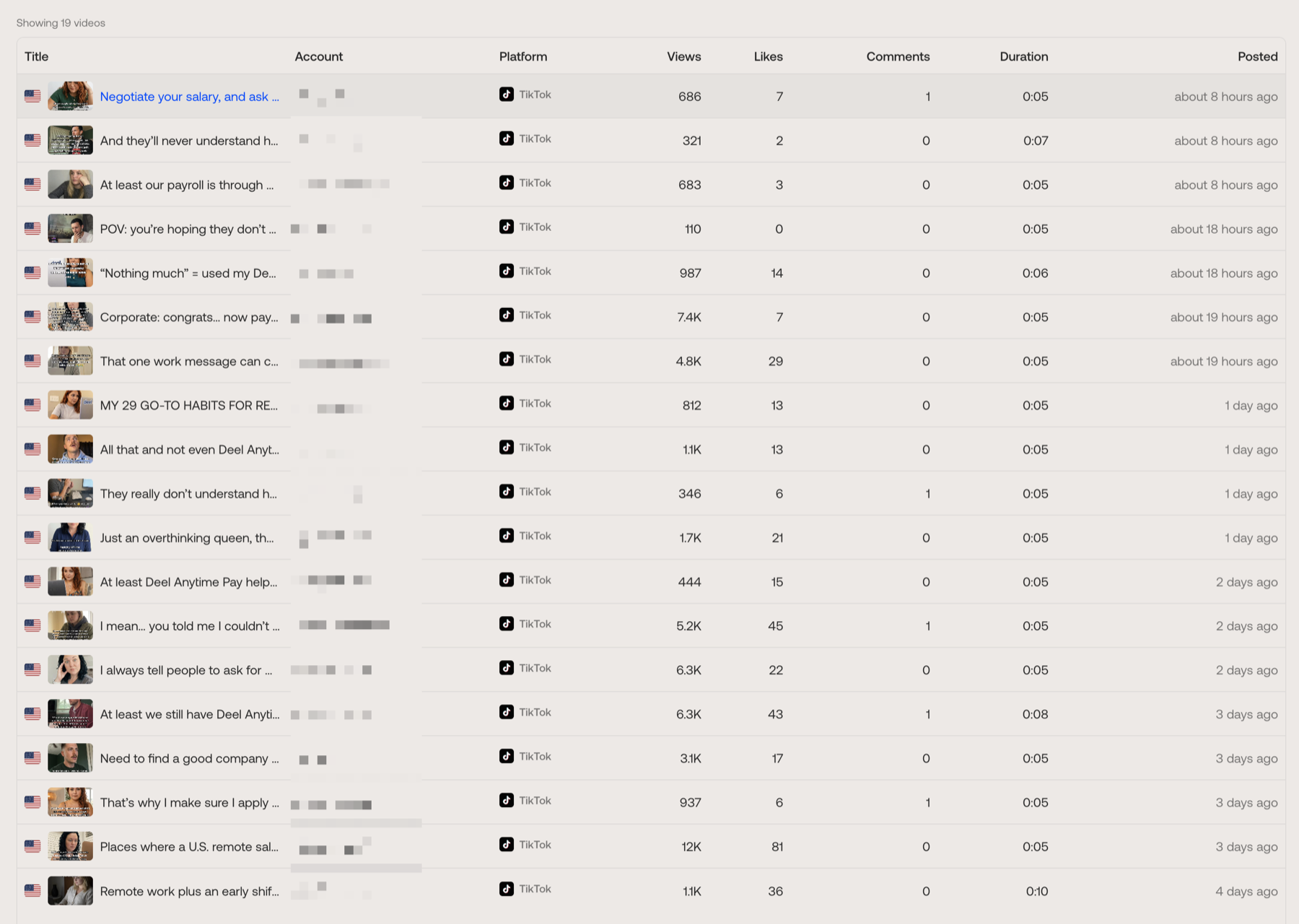
My AI UGC account portfolio in operation. Account names are anonymized; the visible distribution range is the useful evidence.
The spread is the point. Several posts earned thousands of views while others stayed below 1,000 inside the same live system. This proves the operation was publishing and receiving distribution; it does not prove why any single post won. That requires comparing the format, hook, account, and posting conditions.
Check 4: compare formats, not just posts
Suppose the last six reaction videos died, but two slideshows still earned saves.
That is not an account-wide death. It is evidence about the reaction batch.
Group recent posts by:
- format;
- avatar;
- hook family;
- source motion;
- product placement;
- CTA;
- topic.
Example:
| Group | Posts | Result | Working theory |
|---|---|---|---|
| "How did I not know" reactions | 6 | weak hold, no saves | emotion bigger than payoff |
| Mistake-list slideshows | 3 | normal reach, strong saves | account still distributes |
| Direct demos | 4 | normal hold, weak clicks | product understood, offer weak |
Now the next action is obvious. Do not retire the account. Replace the exhausted reaction angle.
Check 5: originality and rights
TikTok's current Community Guidelines say reproduced or unoriginal content without new creative changes may be ineligible for the For You feed. They specifically call out reused material with someone else's watermark or logo. The same guidelines prohibit copyright and trademark violations.
Read the current TikTok integrity and authenticity rules before building a cloning workflow.
For every reused format, keep:
- source URL or file;
- license or permission;
- what you changed;
- generated frame;
- final output;
- disclosure decision.
Copy the mechanic, not somebody else's finished post.
One source reaction can become several original executions when you have rights to use it, cast your own approved persona, write a new truthful hook, and attach different product proof. Downloading a viral video, removing the watermark, and reposting it is not a content system.
Check 6: AI and commercial disclosure
Realistic AI-generated content needs the correct label. Commercial content needs commercial disclosure.
TikTok's guidelines say realistic AIGC must be clearly labeled and that content promoting a product, brand, or business must use its content disclosure setting. Its AI-generated content guide says the AI label itself does not affect distribution when the content otherwise follows the rules.
Do not treat disclosure as the reach problem without evidence.
Check consistency:
- realistic AI labeled;
- brand relationship disclosed;
- no fake customer story;
- no unauthorized private-person likeness;
- no prohibited or unsupported claim.
If the content only works when viewers think the avatar is a random real customer, you have a creative problem.
Check 7: the account lane still makes sense
Accounts decay when they become category dumpsters.
A study account posts:
- college admissions;
- generic motivation;
- a budgeting app;
- AI news;
- one meme about dating;
- a product demo.
Then the team asks why distribution is unstable.
Write the account promise in one line:
This account helps [person] with [recurring problem] using [recognizable style].
Example:
This account helps overwhelmed high-school seniors survive admissions using blunt mini-guides and occasional GradBro proof.
Every post need not mention the product. Every post should make sense to the same person.
If the line changes every week, the account is not learning a niche. It is being rented by the content calendar.
Check 8: the creative passes the two-second test
Infrastructure advice is addictive because it protects the ego.
If the problem is a proxy, the hook was fine.
Often the hook was not fine.
Watch the first two seconds without context:
- Can I read the text?
- Does the face match the emotion?
- Is there a concrete noun?
- Is the promise believable?
- Does the product appear before curiosity exists?
- Does the post look identical to the last ten?
Weak:
3 apps you need in 2026
Stronger:
the app I open before I send any client invoice
The second gives a person, moment, and implied problem.
Run the full AI UGC quality checklist before blaming the account for video defects.
Check 9: posting behavior is boring and sustainable
There is no magic universal number of posts per day.
The useful questions:
- Can the account maintain quality at this frequency?
- Are posts being dumped in an unnatural burst?
- Is each post meaningfully distinct?
- Is the team reviewing results before producing the next 100?
- Is the posting method allowed by TikTok?
TikTok's guidelines prohibit automation used to register or operate accounts in bulk, distribute high-volume spam, manipulate engagement, or circumvent enforcement. They also say multiple accounts can be used for authentic creative expression, not deceptive purposes.
That is a much better boundary than "three posts per account is safe."
If increasing volume made every post worse, lower the volume. Volume is a testing advantage only while the tests remain legible.
Check 10: device and network changes
Device and region consistency can matter operationally, especially when a legitimate user travels or a team keeps logging in from different places.
Record facts:
- device used;
- posting method;
- account region;
- travel or network change;
- login alerts;
- session resets;
- app version;
- date of the change.
Do not turn that into a guide for hiding location or impersonating a market. TikTok prohibits efforts to manipulate its recommendation system or make an account's actual location hard to determine.
If you operate accounts for a client, use authorized access and documented workflows.
A 72-hour diagnostic, without superstition
This is not a magical recovery pause. It is an evidence-gathering window.
Hour 0
- capture Account check;
- capture recommendation notices;
- export or record the last 20 posts;
- stop scheduled duplicates;
- identify any policy or rights issue.
Day 1
- group performance by format and hook;
- compare the drop against changes in content or operations;
- appeal a named eligibility decision if it is wrong;
- fix disclosures and remove anything you do not have rights to use.
Day 2
Prepare three controlled posts:
- a proven format with a new specific hook;
- a saveable format that previously worked;
- a clear product proof post.
Change one main variable in each. Do not test a new avatar, new niche, new format, new CTA, and new posting time in the same post.
Day 3
Publish on the account's normal cadence. Record:
- eligibility;
- initial hold;
- saves and shares;
- comments;
- profile or product action.
The point is to learn whether distribution is absent across every clean post or whether the last batch simply failed.
Retire, repair, or keep testing
Appeal or repair
- TikTok shows an eligibility issue you can address;
- a rights or disclosure problem is clear;
- account lane drifted;
- one format collapsed while others still work;
- recent hooks became generic;
- posting process changed.
Keep testing
- account status is clean;
- no recommendation notice;
- only a small number of posts underperformed;
- some formats still earn normal signals;
- no operational change explains the variance.
Retire
Retirement should be the last decision, not the first.
Consider it when the account has an upheld restriction, the identity itself cannot be used lawfully, or the account no longer serves a business purpose. Do not replace an account to evade enforcement.
My opinion after running account portfolios
Most account-health advice is too certain.
"Exactly four weeks."
"Exactly three posts."
"Exactly 80% US audience."
"Any post under 200 views means suppression."
Those numbers can describe one operator's experience. They are not platform laws.
I have seen low posts recover without a factory reset. I have also seen good infrastructure carry content nobody wanted. The only reliable operating method is to separate platform state, account state, content state, and normal variance.
Check the official status first. Read the named notice. Inspect the content batch. Compare formats. Fix the smallest evidenced problem.
That is less exciting than a shadowban ritual.
It is also how you avoid killing a healthy account because six mediocre videos hurt your feelings.