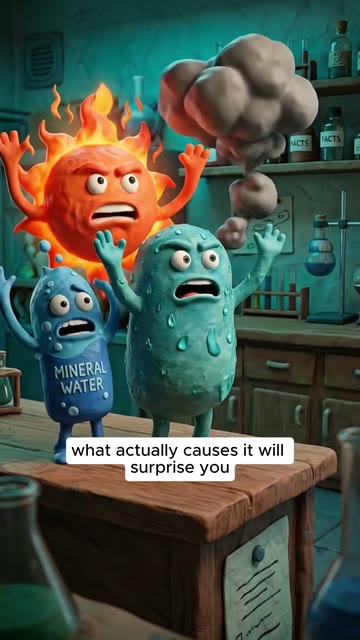
A claymation ad explains a product inside a plasticine world. The people are clay, the food is clay, even the water is clay, and there are thumb prints on everything. It can be made with AI, and one brand is doing it at volume. On November 17, 2026 we counted 10 clearly AI-made clay ads in the Meta Ad Library, and all 10 sell one product. You can make a 45-second one in Ghostfeed for about 38 credits, around $3.80.
Below: what those ads look like, our own example, the steps, the cost and the limits.
Made with GhostfeedThe plant spike in this reel, Sipstake, is an example brand. It is not a real product.
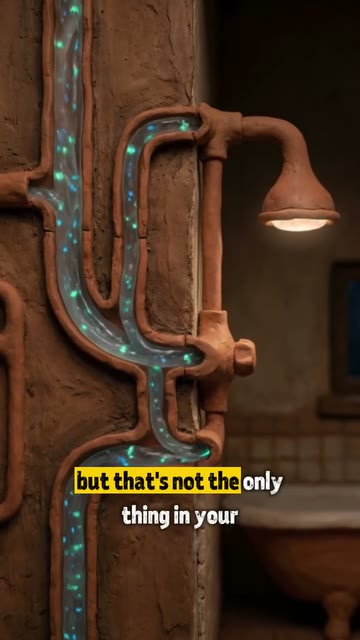
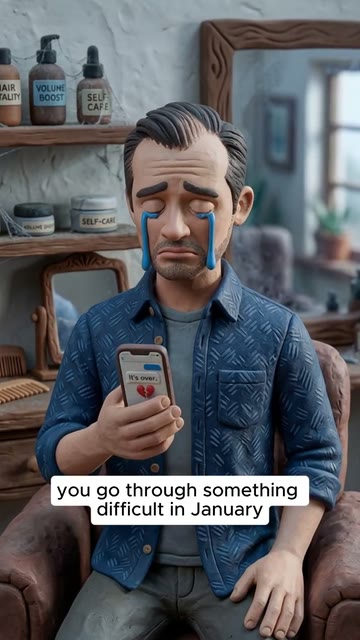
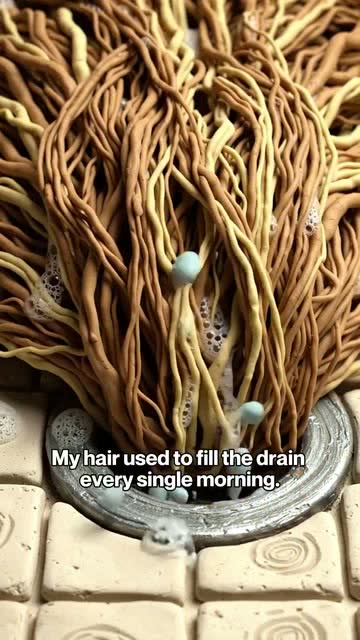
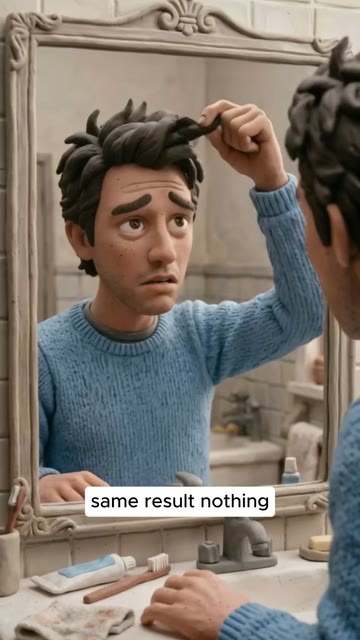
The pictures and clips in this reel were generated with Pruna AI models, called directly and following the steps of Ghostfeed's workflow: P-Image for the first pictures, P-Image-Edit for the pictures made from them, and P-Video 2 Pro for the clips.
What a claymation ad is
It is an explainer in a handmade look. The clay makes a dry mechanism friendly: a root can have eyes, a wrong answer can be a red clay X that drops onto the shelf.
People call it "claymation ads", "clay ads", "AI claymation", "clay explainer" or "stop-motion clay". Some people also call Pixar-style cartoon ads "claymation" by mistake.
These ads run on Meta (Facebook and Instagram). That is where we counted them.
How many brands run it
One, as far as we can prove. These are our own numbers, counted on November 17, 2026 in the public Meta Ad Library.
| What we counted | Number |
|---|---|
| Ads we looked at closely | 13 |
| Clearly AI-made clay ads | 10 |
| Brands behind them | 1 (Regrowth+ shampoo) |
| Advertiser pages | 2 (Regrowth+ and Gulf Health Science) |
| Poster pictures scanned across 9 brand searches | 736 |
| Brands with a clay poster in that scan | 1 |
Be clear about what this is. The proof for claymation is thin. It is one hair-care product sold to the Gulf states, with many clay ads. We looked for a second brand and did not find one:
- Six brands that run other AI formats had no clay ad among their top active ads.
- Three brands that others named as running clay ads did not show up in the Ad Library when we searched.
- Writers who say clay is doing well on Meta name no advertiser.
What the one brand does tell you: 7 of its 10 clay ads started between April 23 and April 30, 2026 and were still running on November 17, about seven months later. Advertisers do not usually keep paying for ads that do not work, but the Ad Library shows no spend and no views, so that is our reading and not a number.
The 10 claymation ads we found
Every ad in the count above, as the Meta Ad Library showed it on November 17, 2026. Tap a picture to open the ad in the Library.
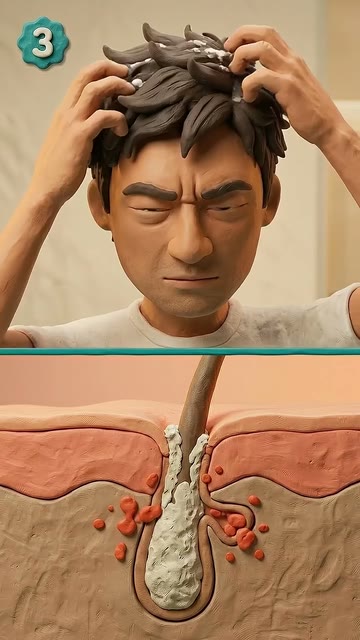
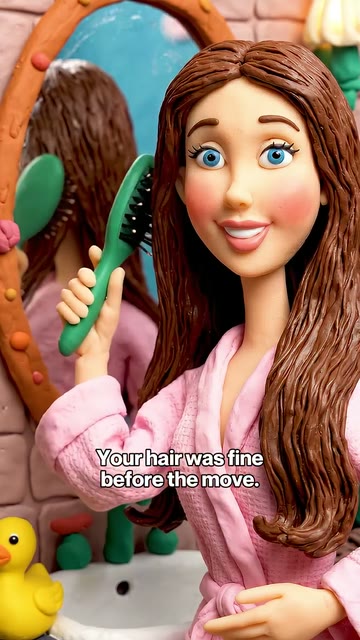

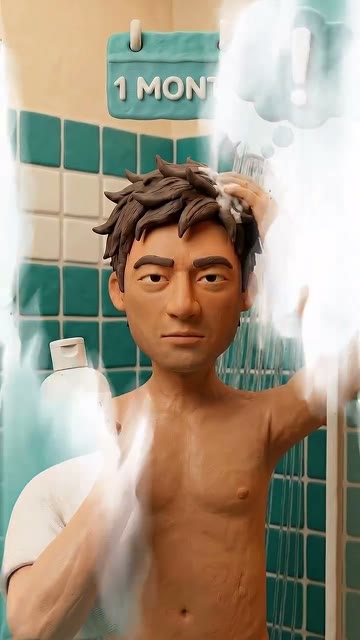
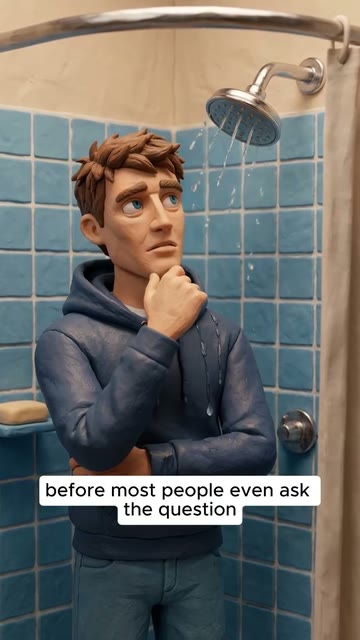
How the real ads are built
Length
The shortest of the 10 is 47 seconds and the longest is 2 minutes 38 seconds. The middle length is 1 minute 10 seconds.
The hook
All 10 open on the problem, aimed at one group of people. 5 of the 10 name the group in the first line. Common shapes: "if you bought X to fix this, I need to tell you something", "is stress causing this?", "five signs your product is making it worse".
How the product shows up
Late. In the 8 ads where the transcript caught the name, the product is first named about 62% of the way through. The problem and the mechanism come first.
Shots and pace
We measured the 47-second Regrowth+ ad shot by shot:
- 17 shots in 47.4 seconds, about 2.8 seconds each.
- One narrator, about 150 words, speaking from the first frame.
- The script goes: the people who fixed it did not do A or B, they did this. It was fine, then it was not. Here is what nobody told you. The mechanism. That is why nothing worked. The product in three steps. How to use it. A risk-free offer. Tap below.
- Every shot is a new plasticine set. 6 different clay people, none repeated.
- The explainer shots have sculpted clay letters, cross-sections and ingredient mascots with eyes.
- The product is a clay bottle with a readable label, shown 3 times in the last 12 seconds. It is first named at 23 seconds.
- Captions are small white text with a thin dark outline, 3 to 6 words on two lines, about 70% of the way down the frame.
- It ends on clay words spelling out the offer.
Our example: a 45-second claymation ad
We made the reel at the top of this page for an example brand, Sipstake, an invented self-watering plant spike. Houseplant care is nothing like hair care, and the script makes no numbers or result claims.
| Our reel | |
|---|---|
| Length | 44.7 seconds, vertical |
| Shots | 17, about 2.6 seconds each |
| Clips made | 11 |
| Voice | One female narrator, 116 words |
| Script | The same order as the real ad, shorter, with no refund offer |
| Sets and people | 6 clay sets and 2 clay people |
| Product | First named at 26 seconds, then on screen in 5 of the last 6 shots |
| Explainer shots | A cutaway pot, root mascots with eyes, a red clay X |
One trick from the edit: every clip is stepped down to 12 frames a second, so the stop-motion feel holds even where the motion came out smooth.
How we made this reel, step by step
This is the whole process, in the order we did it, with the real pictures and the real prompts. Long prompts are trimmed with "…".
One thing to be clear about: we generated the pictures and clips by calling Pruna's models directly, and the music through Ghostfeed. The steps are the ones Ghostfeed's claymation skill sets out.
1. Study one real ad
We measured the 47-second Regrowth+ ad from the file and set ours beside it.
| The real ad | Our reel | |
|---|---|---|
| Length | 47.4 seconds | 44.7 seconds |
| Shots | 17, about 2.8 seconds each | 17, about 2.6 seconds each |
| Voice | One narrator, about 150 words, starts at 0.0 seconds | One female narrator, 116 words, starts at 0.15 seconds |
| Product first named | 0:23 of 0:47 (49%) | 0:26 of 0:45 (59%) |
| Product on screen | A clay bottle with a readable label, 3 times in the last 12 seconds | A clay spike with a paper label reading SIPSTAKE, in 5 of the last 6 shots |
| People | 6 clay people, none repeated | 2 clay people. The woman from the hook returns at the end |
| Captions | Small white sentence-case text with a thin dark outline, 3 to 6 words, two lines, about 70% down the frame | The same layout and size, in Arial Rounded |
| End | Clay words spelling out the offer | No clay words. The caption says "Link below." |
The shots were counted with ffmpeg's scene detection. It found 16 cuts in the real ad and 15 in ours, because two of our punch-ins are too soft for it to register.
We copied the structure only. The brand, the category, the product, the script wording, the characters, the colours and the label are new.
2. Write the script
116 words:
The friend whose plants never die isn't watering on a schedule. She isn't buying fancier pots. She does one small thing instead.
Your fern looked perfect in the shop. Then it came home, and drooped. Here's what no plant label tells you.
Most houseplants don't die of thirst. They drown. Water pools at the bottom of the pot, and the roots can't breathe.
That's why watering more only made it worse.
A Sipstake is a hollow clay spike. Fill it, and push it into the soil. The soil pulls water through the clay only when it's dry.
So roots drink slowly, and nothing pools.
Not sure? Try one Sipstake on your saddest plant first. Link below.
It follows the real ad's order and is shorter. It makes no numbers or result claims, and it has no refund offer. We sent "Sipstake" to the voice as "Sip-stake".
3. Lock the people and the product
Three pictures that later pictures are made from: the woman, the man and the product. All three were made with Pruna P-Image at 9:16.
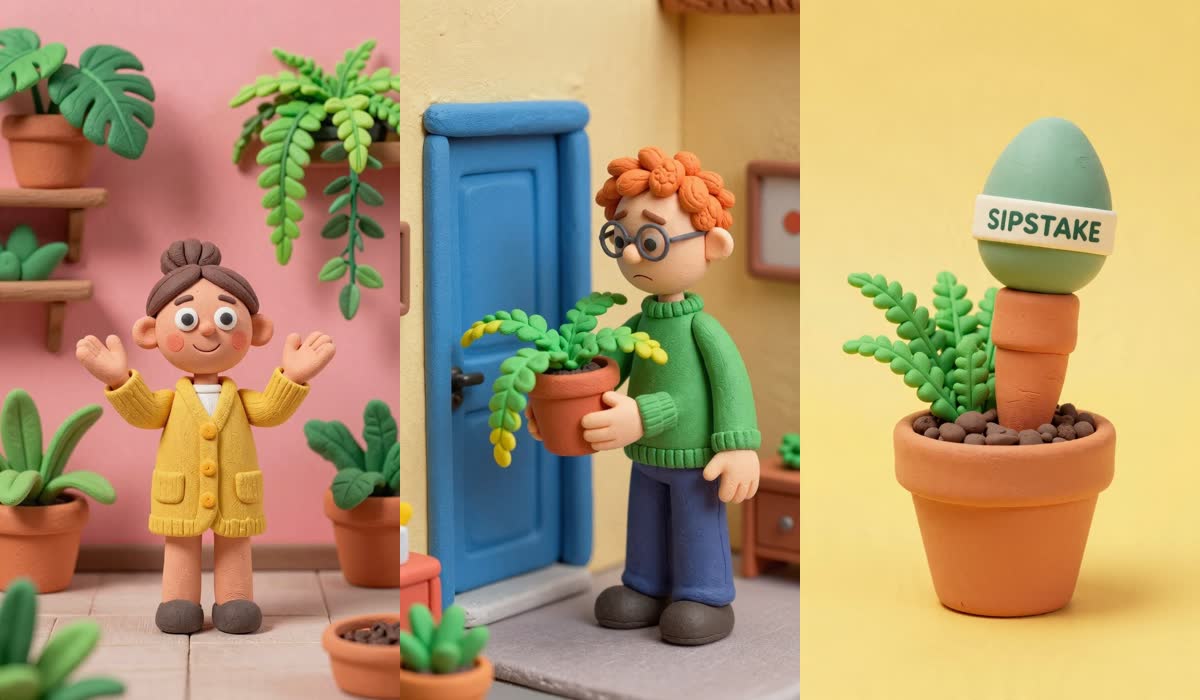 The first picture of the clay woman on the left, the clay man with the drooping fern in the middle, and the Sipstake product picture on the right
The woman's prompt. We made 2 and picked one:
The man was also picked from 2. The product took 5 tries. This is the prompt of the one we kept:
4. Make the scene pictures
13 pictures went into the final reel. 6 were made from words with P-Image. 7 were made from an earlier picture with Pruna P-Image-Edit, at 9:16 with turbo off and 1 or 2 input pictures. That is how the woman, the man, the pots and the product stay the same.
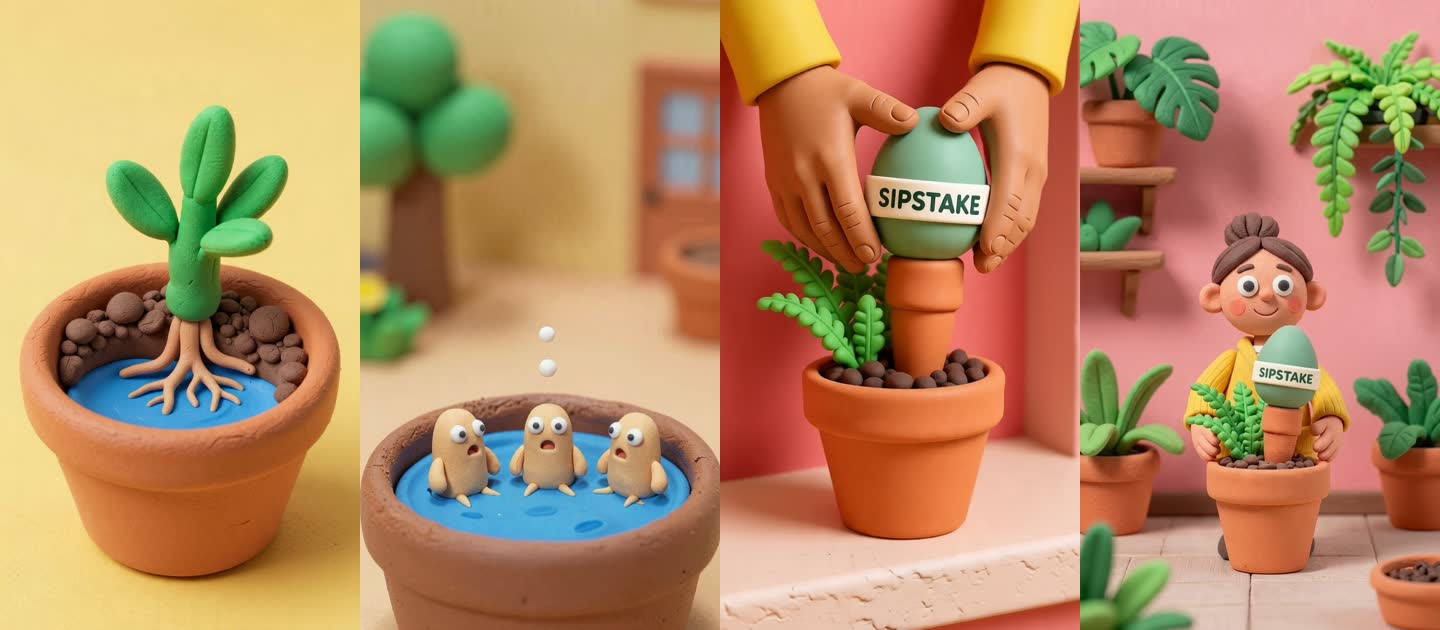 Four of the scene pictures: the cutaway pot with blue clay water, the root mascots in the water, two clay hands pushing the spike into the soil, and the woman holding the fern with the spike
The cutaway pot was made from words. Every picture made from words opens with the same clay sentences as the woman's prompt, and only the end changes:
The closing picture was made from two pictures. The first picture of the woman went in as image 1 and the product picture as image 2:
5. Turn each picture into a clip
Each scene picture is the first frame of one clip. The model was Pruna P-Video 2 Pro, image to video, at 480p, 5 seconds, 9:16. 480p is the lowest resolution the model offers. 10 of the 11 clips in the reel were made in cost mode, the cheapest. The hook clip alone was made in quality mode. Each clip came back 5.17 seconds long.
Before the full run we made the same clip in cost mode and in quality mode. The clay look held equally in both, so we used the cheapest.
The clip of the cutaway pot:
Every clip prompt opens with the same first sentences. One clip also got an end picture: the shelf of pots is the first frame and the same shelf with the red clay X is the last frame, so the X drops in during the clip.
6. Redo what came out wrong
This reel has no second cut. All the redos happened while we were making it.
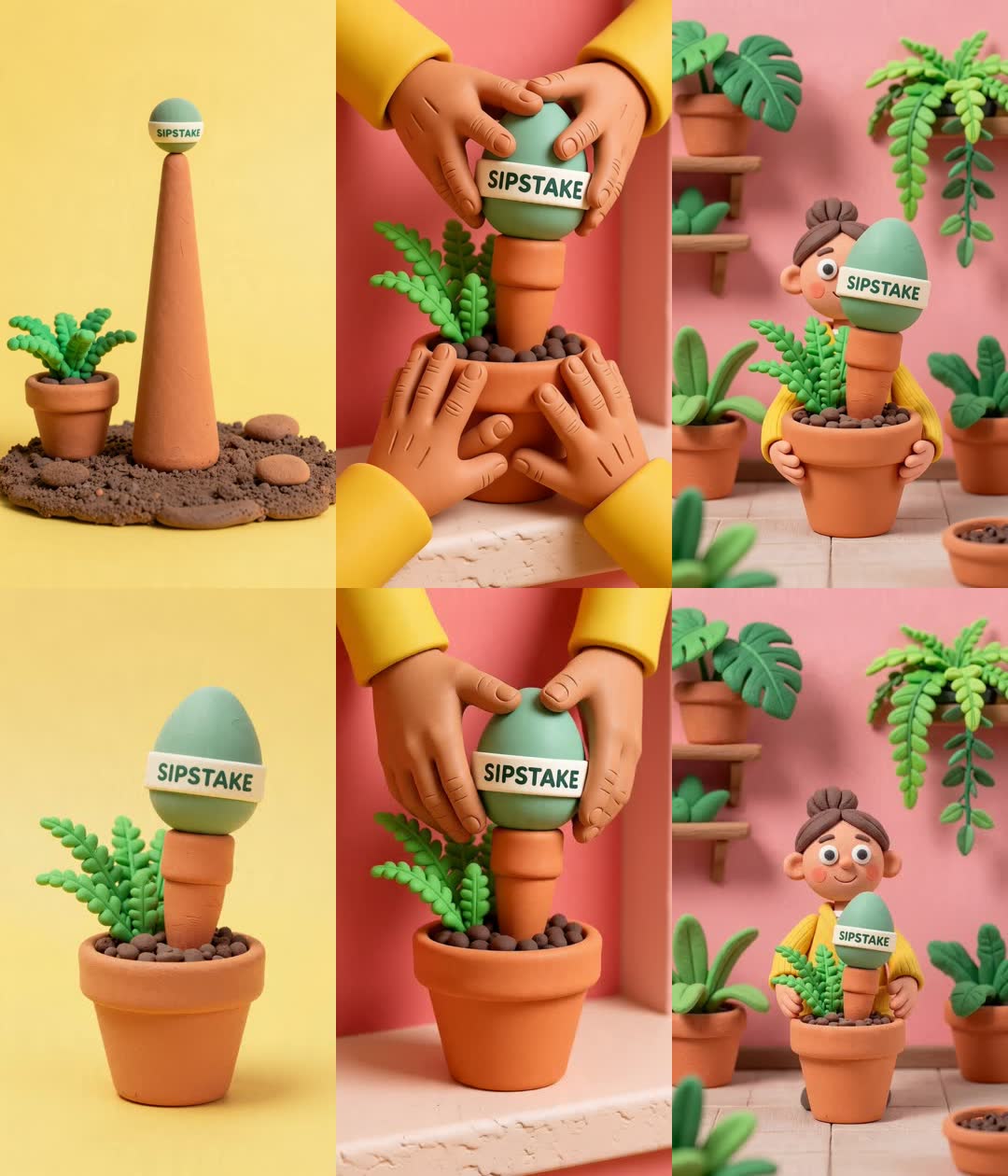 Top row, thrown away: a free-standing cone for the product, four hands on the pot, and the bulb in front of the woman's face. Bottom row, the pictures we kept for the same three shots
- The product, 4 pictures thrown away. A free-standing 30 cm cone, and two that looked like a carrot.
- The hands picture, 2 thrown away. One had three hands and one had four. The one we kept has two.
- The closing picture, 3 thrown away. In one the woman waves with the pot on the floor. In two the bulb is in front of her face. A clip made from one of those was replaced too.
- The hook clip, 1 take. In cost mode she dropped the shrug and closed her eyes in the first second. The quality mode take keeps the shrug.
- One product clip. It was a second product shot with nothing happening. We replaced it with the cutaway where droplets seep from the spike to the roots.
In all we made 31 pictures to keep 13, and 15 clips to keep 11. One more thing went wrong that was not a picture fault: Pruna answered "400 Bad Request" twice when a 307 KB picture was sent to the edit model, and accepted a 101 KB copy of it.
7. Voice, music, captions and the edit
- Voice. Inworld text to speech, voice Ashley, at a speaking rate of 0.88, with word timings. We made 4 takes.
- Music. Made through Ghostfeed, 1 credit, instrumental, 50 seconds. The prompt: "Playful handmade stop-motion ad underscore, ukulele, glockenspiel, soft hand claps, light upright bass, 104 BPM, warm, quirky, cheerful, clean production". We used the first of the 2 versions.
- The edit. Done with ffmpeg. Each clip runs at 0.72 to 1.2 times speed to fit its line. Each is stepped down to 12 frames a second and scaled up from 480x832 to 1080x1920 with a sharpen. The 11 clips are cut into 17 shots, and 6 of those are punch-in crops of 1.18 to 1.5 times.
- Captions. From the voice's word timings, in Arial Rounded.
- Mix. The music sits about 17 dB under the voice.
8. What it really cost us
This is what we paid to make the reel by calling the models directly, counted from our own log at Pruna's list prices and the clip lengths that came back. It is not read from an invoice.
| What | Number | Dollars |
|---|---|---|
| P-Video 2 Pro clips at 480p: 13 in cost mode, 2 in quality mode. 11 used | 15 | 1.09 |
| Pictures: 15 with P-Image, 16 with P-Image-Edit. 13 used | 31 | 0.23 |
| Voice, 4 takes of 639 characters | 0.06 | |
| Music, 1 Ghostfeed credit | about 0.10 | |
| Total | 1.48 |
The list prices are $0.005 for a P-Image picture, $0.01 for a P-Image-Edit picture, and for a 480p clip $0.01 a second in cost mode and $0.04 a second in quality mode. So a cost mode clip was about $0.05 and a quality mode clip about $0.21.
The voice figure is an estimate at $25 per million characters. We did not read Inworld's price list. The two refused edit requests are not counted, because they were refused before anything started.
The same ad priced in Ghostfeed credits is in the cost section below.
9. The finished reel
Made with GhostfeedHow to make one in Ghostfeed
Ghostfeed connects to Claude, ChatGPT, Codex and Cursor through one MCP server. Setup takes a couple of minutes. You ask for the ad in plain words:
The agent reads Ghostfeed's method for the clay look and works through these steps.
- Write the words. The problem, what nobody told you, the mechanism, the product, how to use it. About 115 words for 45 seconds.
- Open every picture prompt with the same clay sentence. A stop-motion frame on a miniature plasticine set, fingerprints and tool marks, a soft matte sheen, bright warm daylight, "not a 3D render, not CGI". Never "smooth" or "glossy".
- Keep it bright. No dark or cold scenes.
- Describe the hands and the water as clay. "Sculpted clay hands, blunt tips, no fingernails." "Blue clay water."
- Make the product in clay, with a real paper label. Write the word on the label out in the prompt.
- Make the voiceover first, then one start picture per line. Pictures that repeat a person or the product are made from the earlier picture.
- Open every clip prompt with the cadence. "12fps stop-motion cadence, no motion blur, not CGI."
- Put it together. Join the clips, lay the voiceover and music on top, and add the captions.
What a 45-second one costs
Counting a credit as 10 cents, with today's prices and the settings our reel used:
| Part | Credits |
|---|---|
| 6 pictures made from words, 1 credit each | 6 |
| 7 pictures made from another picture, 2 credits each | 14 |
| 10 clips of 5 seconds at 0.25 credits a second | 12.5 |
| 1 clip of 5 seconds at 0.75 credits a second | 3.75 |
| Voiceover, 639 characters (1 credit per started 1,000) | 1 |
| Music, one song request | 1 |
| Total | about 38, around $3.80 |
Three notes on that table:
- These are 480p prices for P-Video 2 Pro. 0.25 credits a second is its cheapest mode. Clay hides low resolution better than a real-looking face does, so we used the cheapest mode for all but the opening clip.
- The clips add up to 55 seconds for a 45-second ad. A clip is 5 seconds at least, and several are on screen for 2 or 3 seconds.
- Redos cost again. For our reel we made 31 pictures to keep 13, and 15 clips to keep 11.
Ghostfeed is paid, from $29/mo.
Honest limits
What is still wrong with our own reel:
- It is soft. The clips are 480p scaled up. On a desktop the close crops are visibly soft and part of the fingerprint texture is lost. The real ad is sharper and its thumb prints are crisp.
- Fewer worlds and people. The real ad builds 17 different clay sets with 6 people. Ours has 6 sets and 2 people, and reaches 17 shots by cutting into the same clips.
- No sculpted words. The real ad has clay lettering in the scene. Ours has none except the label, so the comparison shot and the offer card are missing.
- The spike is too big and changes shape a little. In one shot it sinks into the soil further than it could.
- The cutaway is not a true cross-section. It is a pot seen from above with the roots showing.
- The stop-motion is partly an edit trick. The push-ins are a stepped smooth move, not true frame-by-frame animation.
We made this reel at 480p, the lowest resolution, in low-cost settings. Higher-end video models and a higher resolution reduce the picture problems in this list. We have not measured by how much.
What to expect from the tool:
- Each line is its own clip. In Claude Code, Codex, Cursor and the Ghostfeed app the clips are joined into one file. In Claude and ChatGPT chat you get the clips in order and join them yourself.
- Captions are added when you ask for them.
- The agent cannot hear the voiceover, so you choose the voice by listening.
FAQ
What is a claymation ad?
A video ad that explains a product inside a plasticine world, where the people, the product and even the water are clay.
Do real brands run AI claymation ads?
One that we can prove. On November 17, 2026 we counted 10 clearly AI-made clay ads in the Meta Ad Library, all for Regrowth+ shampoo. We did not find a second brand.
How long are they?
From 47 seconds to 2 minutes 38 seconds. The middle length is 1 minute 10 seconds.
How do you make AI video look like clay and not 3D?
Open every picture prompt with the same clay sentence, ask for fingerprints and tool marks, avoid the words "smooth" and "glossy", and ask for a 12 frames a second stop-motion cadence in every clip.
How much does one cost to make?
About 38 credits for 45 seconds in Ghostfeed at 480p, around $3.80 at 10 cents a credit, before redos.
Make this format with the Ghostfeed skill
The clay look on this page is written down as a skill on the Ghostfeed MCP server, ghostfeed-ad-style-claymation. It covers what makes a picture read as clay: fingerprints and tool marks, a bright miniature set, clay hands, a clay product with a real paper label, and the 12 frames a second line in every clip. It works together with ghostfeed-video-ads, which covers the order of work for any video ad: the words, the reference pictures, the sound, one start picture per clip, the clips, and putting it together. Connect Ghostfeed to Claude or ChatGPT, ask for a claymation ad for your own brand, and the agent reads both skills and runs the same steps.
Our reel was made by hand along those steps, with Pruna's models called directly and the music made through Ghostfeed. The skill runs the same steps inside Ghostfeed, with the models Ghostfeed offers.