A skeleton ad is a short video where one friendly skeleton lives through a count of days or weeks while a narrator talks to "you". "Day 1. Day 7. Day 30." Brands are running it right now as an AI-made ad. On November 17, 2026 we counted 24 clearly AI-made skeleton ads from 18 brands in the Meta Ad Library. You can make a 45-second one in Ghostfeed for about 71 credits, around $7.10.
Below: what the real ads look like, our own example, the steps, the cost and the limits.
Made with GhostfeedThe lamp in this reel, Dawnlo, is an example brand. It is not a real product.
The pictures and clips in this reel were generated with Pruna AI models, called directly and following the steps of Ghostfeed's workflow: P-Image for the first pictures, P-Image-Edit for the pictures made from them, and P-Video 2 Pro for the clips.
What a skeleton ad is
The viewer is the skeleton. It has no age, no gender and no skin colour, so "you" means whoever is watching. The story is a ladder: a label on screen says "DAY 1", then "DAY 7", then "DAY 30", and each step shows a small physical change.
People call it "skeleton ads", "Skeleton Story" or "skeleton stories". The hook people type and write is "what happens if you take X for 30 days".
These ads run on Meta (Facebook and Instagram). That is where we counted them.
How many brands run it
These are our own numbers, counted on November 17, 2026 in the public Meta Ad Library. We looked at ten frames across each ad, not at the first picture, and counted an ad only when it was clearly AI-made.
| What we counted | Number |
|---|---|
| Clearly AI-made skeleton ads | 24 |
| Brands behind them | 18 |
| Ads we looked at and rejected | 0 |
| Supplements | 17 of 24 |
| Sleep products (mouth tape) | 3 of 24 |
| Comfort products (seat cushions) | 2 of 24 |
| Fitness gear | 1 of 24 |
| Weight loss | 1 of 24 |
The 18 brands: Bettervits, By Velura, Dr. Susan Hartley, Elavate, Hippie Farms, Ilyra, Jevawell, Ji Martial Arts, NilPoint, Nutrition Geeks, Pureflowtape, Purely Nutrient Black Seed, Shopee, Sondur, The New You Plan, True Nutra, Try Respire and Zapply.
Three things worth knowing about these numbers:
- 24 is a floor. We searched by hook phrases and a few brand pages. Ads that use other words are not in the count.
- Some of these ads have run for months. Pureflowtape's ad started on April 14, 2026 and was still active on November 17. Jevawell's started on May 4, 2026.
- The Ad Library shows no spend and no views. We can say an ad is running. We cannot say how well it does.
The 24 skeleton ads we found
Every ad in the count above, as the Meta Ad Library showed it on November 17, 2026. Tap a picture to open the ad in the Library.
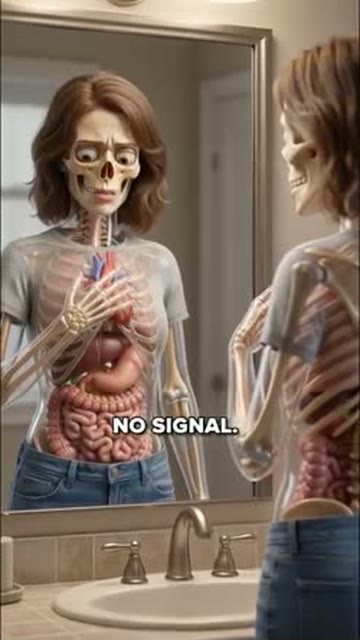
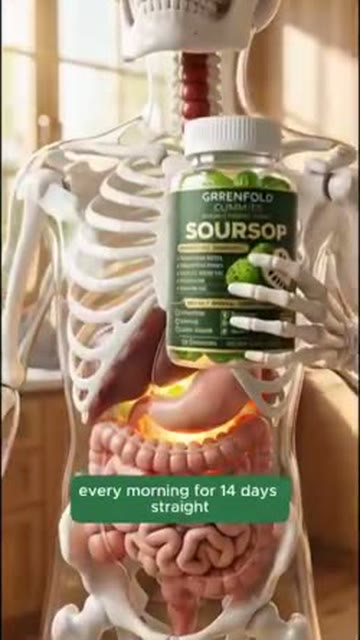
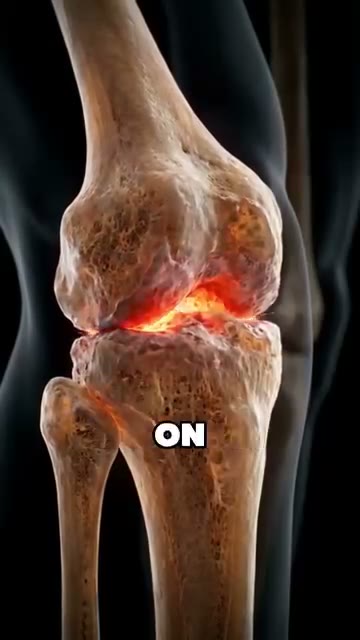


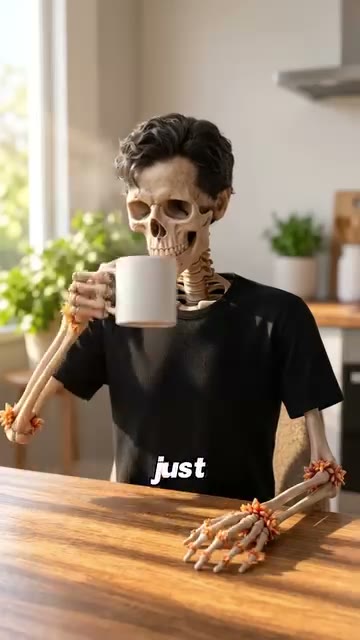
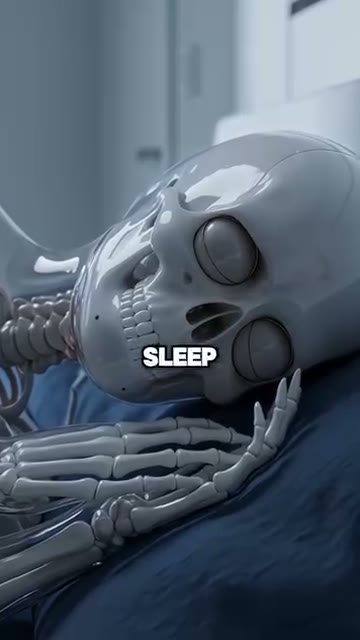

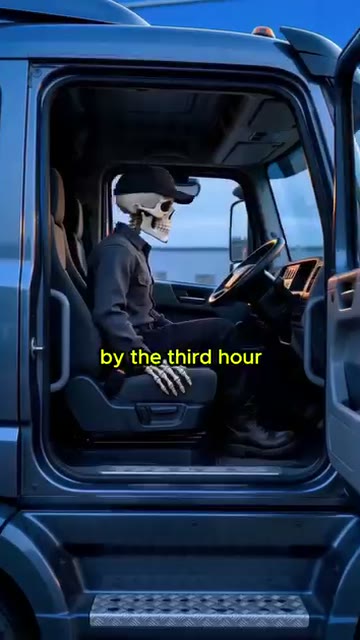
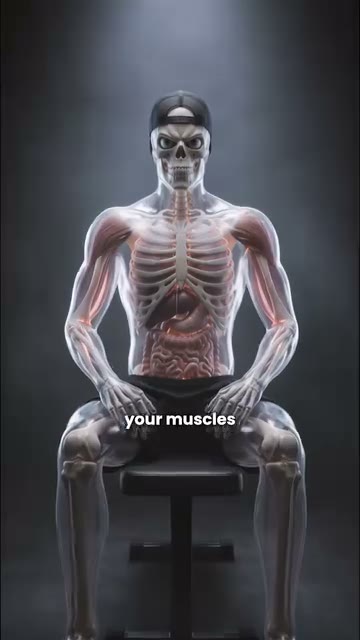
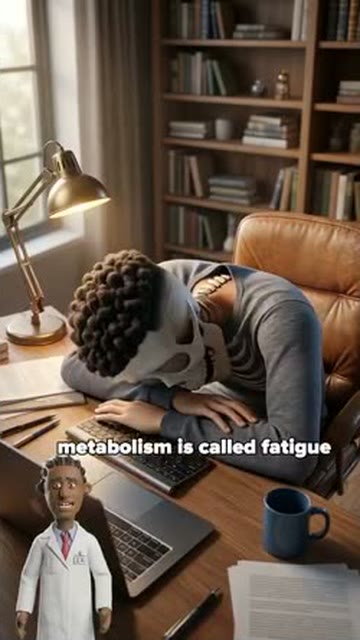
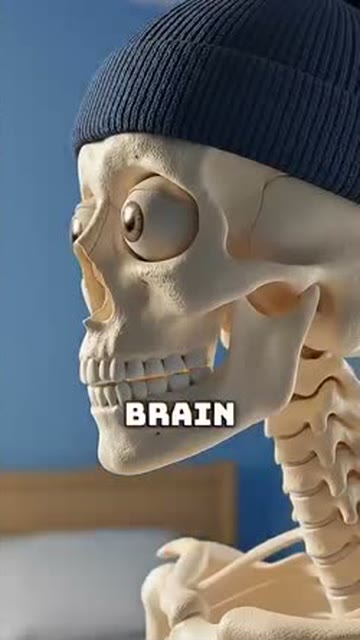
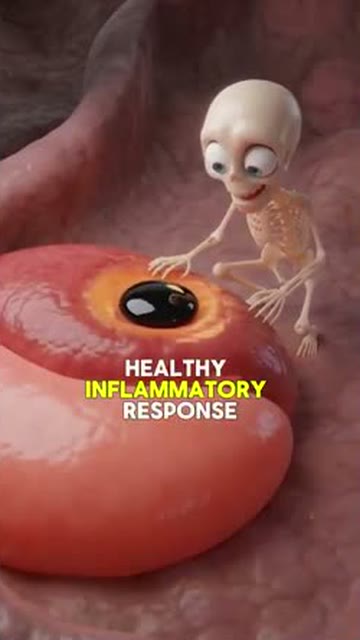



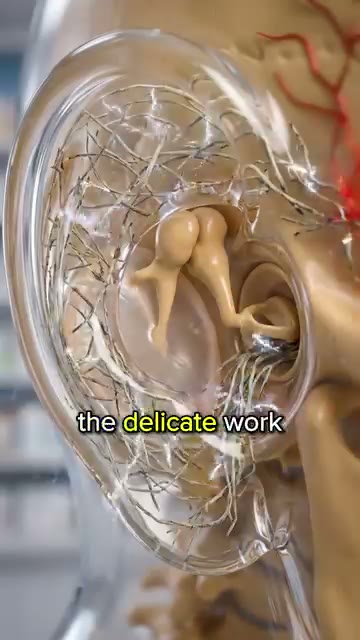
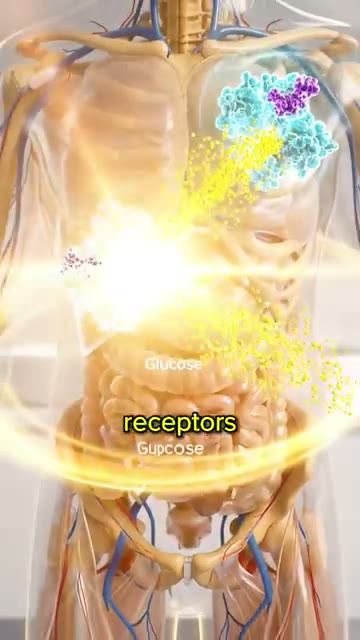

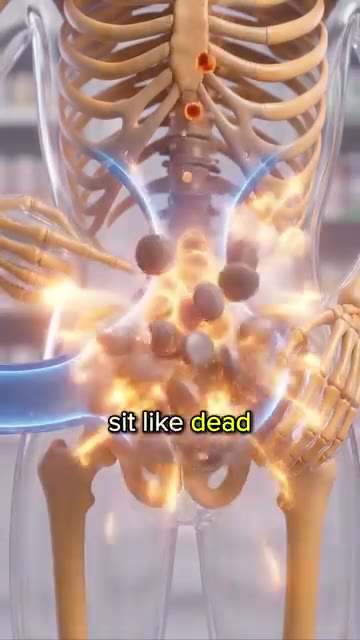
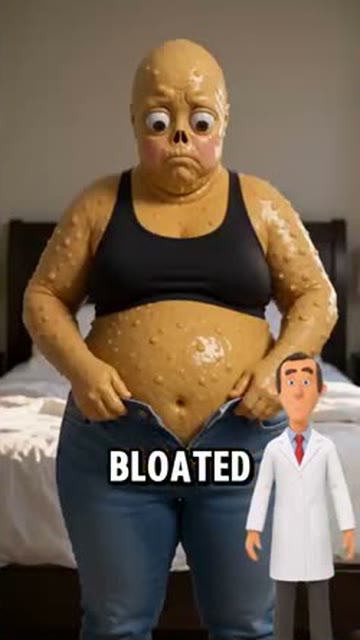

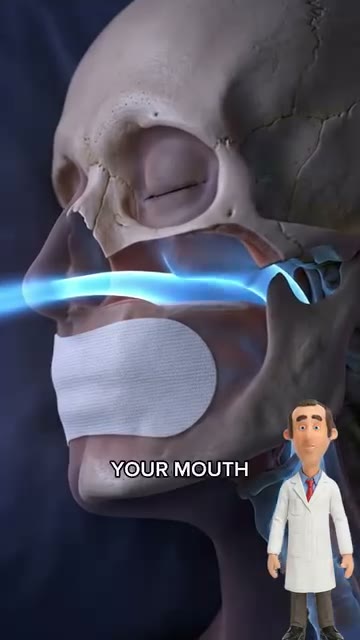
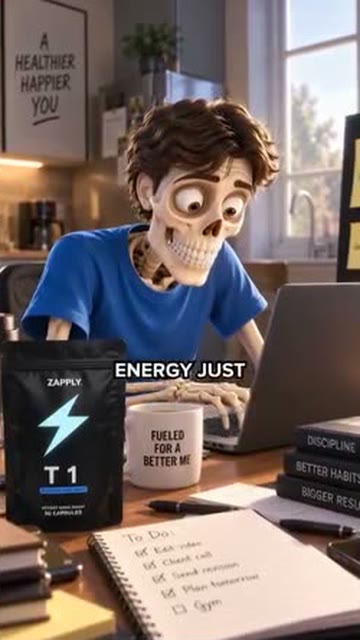
How the real ads are built
Length
The shortest of the 24 is 8 seconds and the longest is 4 minutes 19 seconds. The middle one is 1 minute 10 seconds. Only 3 of the 24 run 35 seconds or less. If you plan a skeleton ad, plan for 45 seconds to 2 minutes, not 15.
The hook
Half of them use a time ladder. 12 of the 24 show a count of days, weeks, nights or hours on screen or in the ad text: "DAY 30", "DAY 7", "Night 1", "By week six". The question form, "what happens when someone takes X for N days", is readable in 3 of the 24.
So the ladder is the format. The question is one way to open it.
Three looks, and a fourth
- A bare cartoon skeleton. Real-looking bones, big friendly eyes, one accessory. Pureflowtape uses a skeleton in a navy beanie in a blue room, 43 seconds long.
- A clothed person with a skull face. Hair, clothes and a skull. NilPoint shows a skull-faced trucker on a truck seat. Sondur puts skeletons in clothes on plane seats.
- A see-through body. A glass body with bones and glowing organs inside. Hippie Farms and Nutrition Geeks both use it for supplements.
- A skeleton at a flipchart. True Nutra Direct opens on a skeleton pointing at a flipchart, then cuts to close-ups of the skull.
Shots and pace
We measured Pureflowtape's 43-second ad shot by shot:
- About 18 to 20 shots, around 2.3 seconds each. Four cuts in the first 3.2 seconds.
- One male narrator, 122 words, about 170 words a minute. He starts speaking at the first frame.
- The camera is still or pushes in slowly. Many close-ups of the skull, a few wide shots.
- Captions appear one word at a time, white with a black outline, in the lower third.
- A large "DAY N" label sits at the top of the frame.
- Bright, flat daylight in one saturated blue room.
How the product shows up
The product is not saved for a twist at the end. In Pureflowtape's ad the mouth tape is on the skeleton in almost every shot, and the skeleton holds the product up at the end. The ladder counts days of using the product, so each step is a little better than the last.
Other ads end on something filmed. Nutrition Geeks ends its skeleton ad on a filmed pouch. By Velura goes further the other way: only the first two shots are an AI skeleton, about a fifth of the ad, and the rest is filmed creators.
Our example: a 45-second skeleton ad
We made the reel at the top of this page to test the format on a product that is not a supplement. The example brand is Dawnlo, an invented sunrise lamp that brightens slowly instead of ringing.
| Our reel | |
|---|---|
| Length | 44.6 seconds, vertical |
| Shots | 23, about 1.9 seconds each. 3 shots in the first 4.2 seconds |
| Clips made | 9, one per line of the script |
| Voice | One male narrator, 115 words, about 160 words a minute |
| Ladder | Day 1, Day 7, Day 14, Day 21, Day 30 |
| Captions | One word at a time, lower third, with a "DAY N" label at the top |
| Product | On the nightstand in 6 of 9 scenes, held up at the end |
The script opens on a question, climbs the five days, and closes on one line about the product. It makes no claim beyond the day count.
How we made this reel, step by step
This is the whole process, in the order we did it, with the real pictures and the real prompts. Long prompts are trimmed with "…".
One thing to be clear about: we generated the pictures and clips by calling Pruna's models directly, and the music through Ghostfeed. The steps are the ones Ghostfeed's skeleton skill sets out.
1. Study one real ad
We measured Pureflowtape's 43-second ad and set ours beside it.
| The real ad | Our reel | |
|---|---|---|
| Length | 43.1 seconds | 44.6 seconds |
| Shots | About 18 to 20, about 2.3 seconds each | 23, about 1.9 seconds each |
| Voice | One male narrator, 122 words | One male narrator, 115 words |
| Script shape | A question, then Day 1, 7, 14, 21, 30, then one line on the product | The same |
| Captions | One word at a time, white with a black outline, lower third | The same layout, in our own font |
| Day label | "DAY N", large, at the top | The same |
| Product | On the skeleton in almost every shot, held up at the end | On the nightstand in 6 of 9 scenes, held up at the end |
We copied the structure only. The brand, the product, the words, the accessory, the room colour and the font are all different.
2. Write the script
115 words, one line per clip:
What happens if you wake up to light instead of an alarm, for thirty days?
Day one. No alarm. The lamp glows like a slow sunrise, and you wake up confused.
Your hand still slaps the nightstand, hunting for a snooze button that isn't there.
Day seven. Your eyes open before the room is even bright. No jolt. No panic.
Day fourteen. You stop bargaining for five more minutes. You just get up.
Coffee becomes a choice, not a rescue.
Day twenty-one. You get sleepy at the same time every night, like clockwork.
Day thirty. Mornings feel calm. You're up and stretching before your phone makes a sound.
One Dawnlo lamp. A whole new morning.
It makes no claim beyond the day count. We sent "Dawnlo" to the voice as "Dawn-low" so it is said right.
3. Lock the skeleton and the product
Two pictures that every scene is made from. Both were made with Pruna P-Image at 9:16.
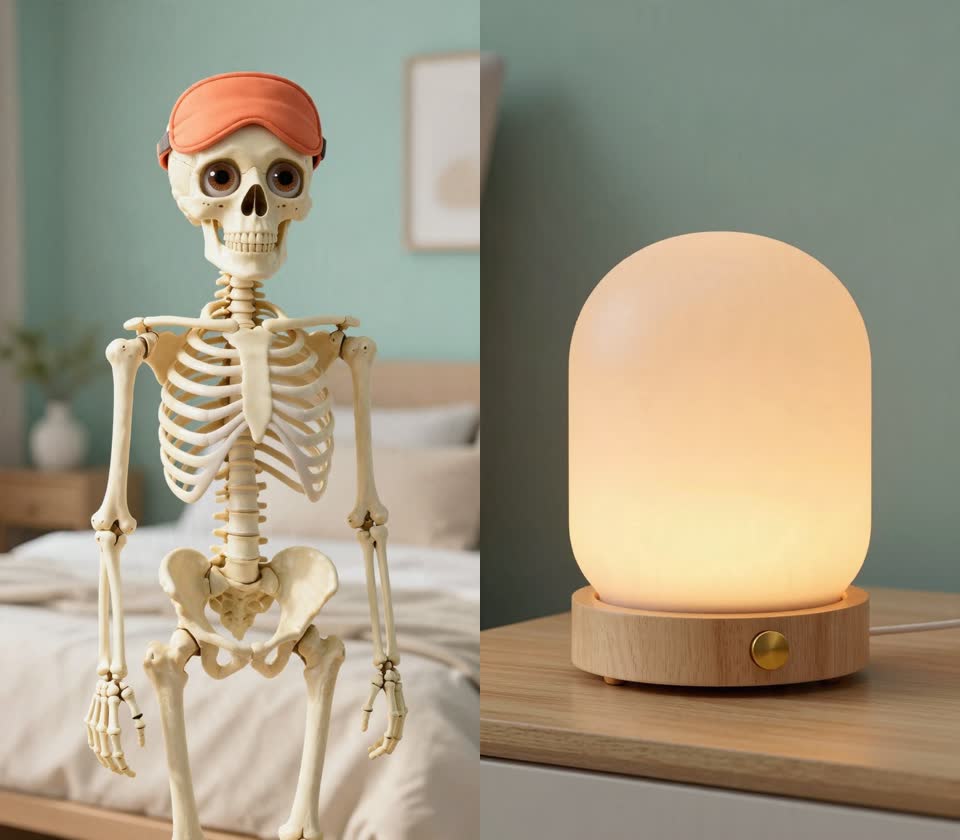 The locked skeleton picture on the left and the locked lamp picture on the right
The skeleton prompt. We made 6 and picked one:
The first three asked for a "3D animated film" look. They came out toy-like with oversized heads, so we rejected them.
The lamp prompt:
4. Make one scene picture per line
Nine scene pictures, made with Pruna P-Image-Edit. The locked skeleton goes in as image 1 and the locked lamp as image 2, and the prompt tells the model to keep both. Scenes with no lamp in them get the skeleton picture only.
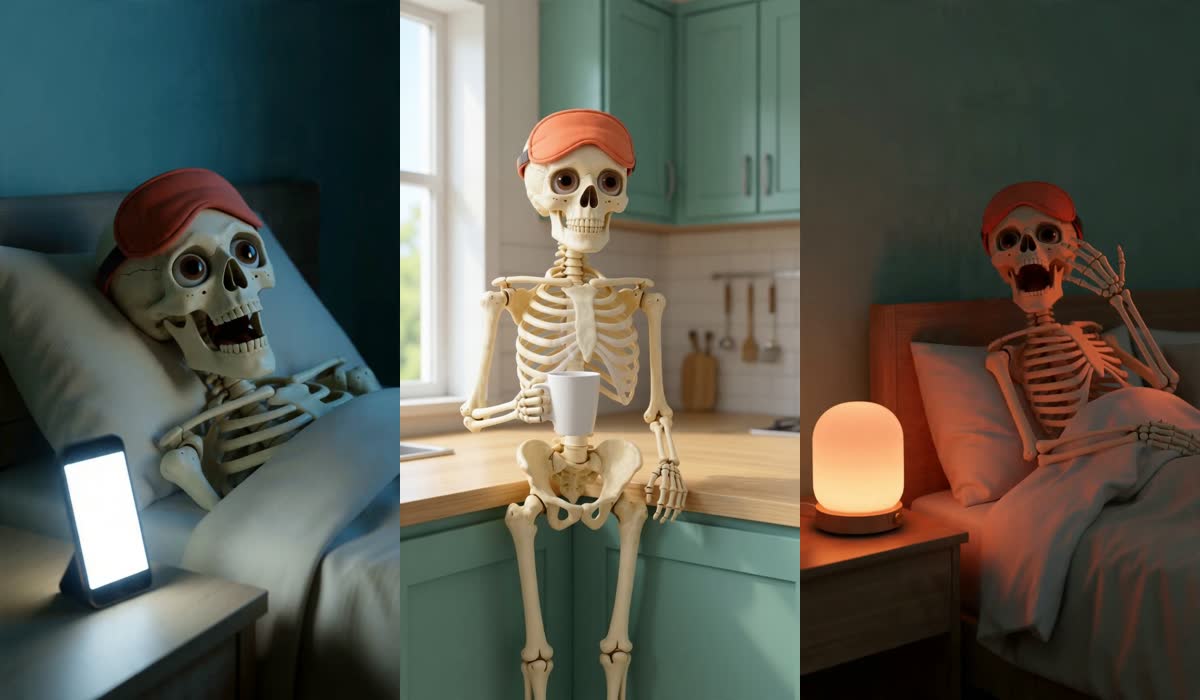 Three of the scene pictures: the alarm hook, coffee in the kitchen on Day 14, and the yawn on Day 21
The Day 21 picture. The settings were the two locked pictures, 9:16 and turbo off:
Every scene prompt opens with the same sentences about the skeleton, the lamp and the room. Only the part after "Scene:" changes.
5. Turn each picture into a clip
Each scene picture is the first frame of one clip. The model was Pruna P-Video 2 Pro, image to video, at 768p in quality mode, 5 or 6 seconds, 9:16.
The third clip, where the hand hunts for a snooze button:
One action and one camera move per clip. Every clip prompt ends with the same closing sentences.
6. Redo what came out wrong
In the first pass we threw away:
- 3 scene pictures. A lamp in the hook, two lamps in one room, and a lamp in the kitchen.
- Hook clip, 2 takes. One cut to a much more cartoon-like face. In the other the skeleton smiled and waved instead of reacting to the alarm.
- The second clip, where the lamp wakes it, 1 take. An orange glow appeared inside the skull.
- Day 14 clip, 1 take. The sleep mask slid down over the eyes and stayed there.
After the first cut was finished we replaced three more shots:
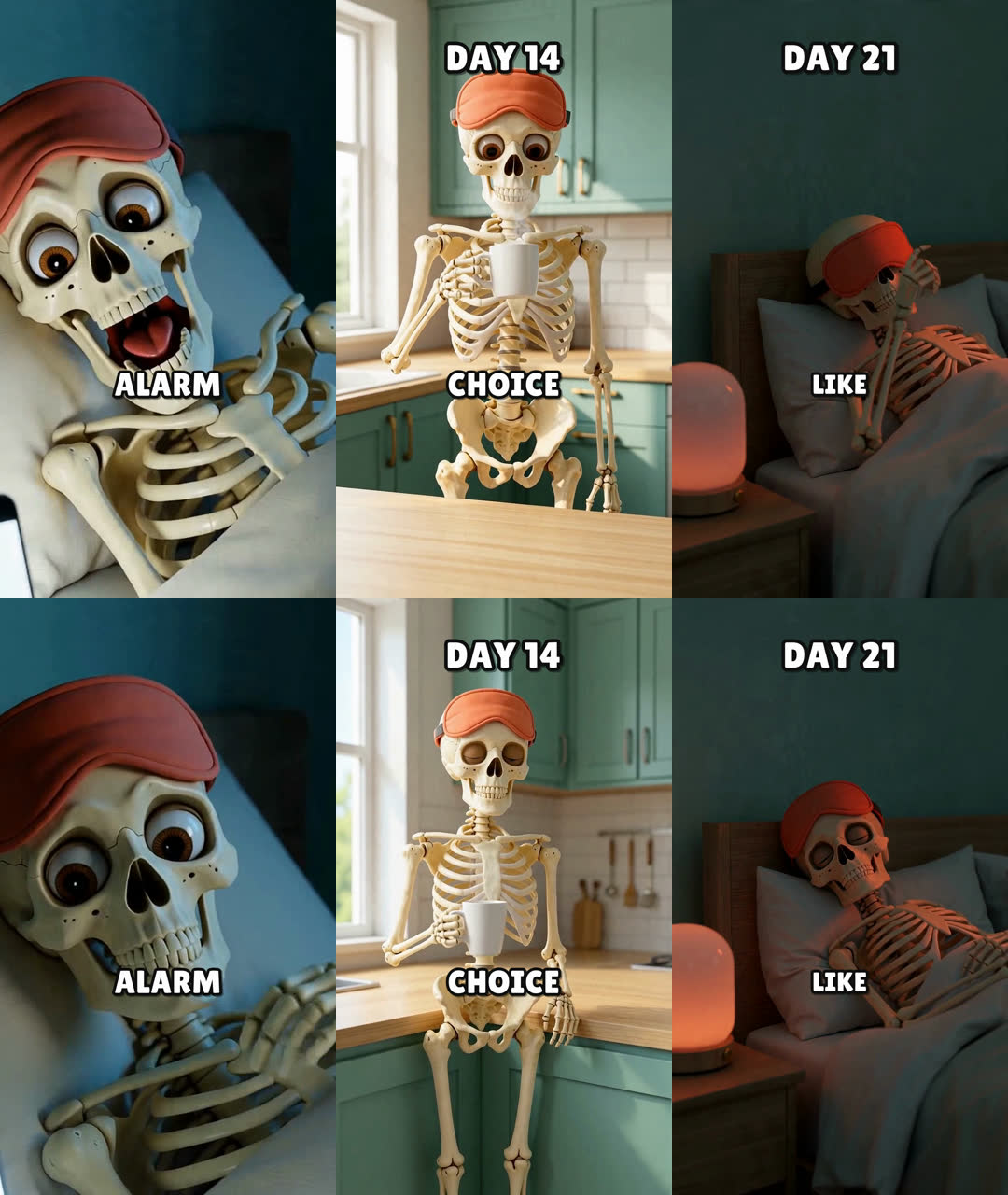 Top row, the first cut: a tongue and a cartoon face in the hook, a mug floating at the ribs, a mask sliding off a doubled skull. Bottom row, the same moments after the redo
| Shot | What was wrong | The fix |
|---|---|---|
| Hook, 0:00 to 0:04 | A third hand on the chest, a glossy cartoon face and a pink tongue | A new clip from the same picture, with the jaw kept shut and one hand only |
| Coffee, 0:24.7 to 0:28 | The mug floated at the ribs | A new picture with the mug held in the hand, then a new clip |
| Day 21, 0:28 to 0:34 | The mask slid down and the skull doubled | A new clip, with the mask told to stay on the forehead |
The new coffee picture is the one picture not made with a Pruna model. It was edited with Nano Banana 2 through Ghostfeed. One more hook take was thrown away because a red tongue was still visible.
7. Voice, music, captions and the edit
- Voice. Inworld text to speech, voice Alex, at normal speed, with word timings. Pauses of 0.4 to 0.45 seconds were added before each "Day" line.
- Music. Made through Ghostfeed, 1 credit, instrumental, 50 seconds. The prompt: "Playful quirky instrumental, pizzicato strings, marimba, light bouncy drums, 110 BPM, curious and upbeat, clean modern ad background music".
- The edit. Done with ffmpeg. Each clip runs at 1.07 to 1.25 times speed to fit its line. 14 of the 23 shots are closer crops of the same 9 clips, which is how 9 clips turn into a cut every 1.9 seconds.
- Captions. One word at a time from the voice's word timings, plus the day label.
- Mix. The music sits about 11 dB under the voice.
8. What it really cost us
This is what we paid to make the reel by calling the models directly, counted from Pruna's list prices and the clip lengths we asked for. It is not read from an invoice.
| What | Number | Dollars |
|---|---|---|
| P-Image pictures: 6 skeletons, 1 lamp | 7 | 0.035 |
| P-Image-Edit pictures: 9 scenes, 3 retakes, 1 test | 13 | 0.13 |
| P-Video 2 Pro clips, 768p quality: 9 used, 4 thrown away | 13 | 5.25 |
| Voice, 3 takes of 636 characters | about 0.02 to 0.05 | |
| Music, 1 Ghostfeed credit | about 0.10 | |
| First cut | about 5.54 | |
| The redo: 4 more clips | 4 | 1.66 |
| The redo: 1 picture edit, 1 Ghostfeed credit | 1 | about 0.10 |
The voice figure is an estimate. We did not read Inworld's price list. Four requests failed and were sent again; if those were billed too, add up to $0.77.
The same ad priced in Ghostfeed credits is in the cost section below.
9. The finished reel
Made with GhostfeedHow to make one in Ghostfeed
Ghostfeed connects to Claude, ChatGPT, Codex and Cursor through one MCP server. Setup takes a couple of minutes. You ask for the ad in plain words:
The agent reads Ghostfeed's skeleton method and works through these steps. The method is public: you can read the skeleton skill on GitHub.
- Write the ladder. The hook, five steps and one closing line. About 2.5 words a second, so 45 seconds is 110 to 120 words. Second person, present tense, one physical picture per line. "Your hand slaps the nightstand" works. "You feel more rested" gives the picture nothing to show.
- Lock the skeleton. One picture that every scene is made from: real-looking bones, big friendly eyes, one accessory. Not scary and not toy-like.
- Lock the product. One clean picture of it, or your own product photo.
- Make the voiceover first. Its word timings set how long each scene is.
- Make one start picture per line. Each is made from the locked skeleton and the locked product, so both stay the same from Day 1 to Day 30.
- Turn each picture into a clip. One action and one camera move per clip: the skeleton sits up, the camera pushes in.
- Put it together. Join the clips, lay the voiceover and music on top, and add the captions and the day labels.
What a 45-second one costs
Counting a credit as 10 cents, and using today's prices for the models Ghostfeed uses for this kind of ad:
| Part | Credits |
|---|---|
| The locked skeleton and the locked product, 1 credit each | 2 |
| 9 start pictures made from those two, 2 credits each | 18 |
| 9 clips, 49 seconds in all, at 1 credit a second | 49 |
| Voiceover, 636 characters (1 credit per started 1,000) | 1 |
| Music, one song request | 1 |
| Total | 71, about $7.10 |
Three notes on that table:
- The clips add up to 49 seconds for a 45-second ad. A clip is 5 seconds at least, and ours are 5 or 6 seconds each.
- 1 credit a second is P-Video 2 Pro at 768p in quality mode. Speed mode is 0.75 credits a second, which brings the clips down to about 37 credits. 1080p in quality mode is 1.25.
- Redos cost again. For the first cut we made 6 skeleton pictures to pick one, redid 3 start pictures and redid 4 clips. At these prices that is 32 more credits. The later redo was 4 more clips of 5 or 6 seconds and 1 picture edit.
Ghostfeed is paid, from $29/mo.
Honest limits
What is still wrong with our own reel:
- The eyes change. In some shots the skeleton has cartoon eyeballs, and in others the sockets are empty.
- Close-ups are soft on a large screen. The clips are 768p, and 14 shots are cropped in further.
- Small glitches stayed in. The sleep mask changes shape between scenes, and the hand rests on the nightstand more than it slaps it.
- Less product than the real ads. Our lamp is a background object until the last scene. Pureflowtape has its product on the skeleton in nearly every shot.
- Three dark scenes. The real ad is bright in every shot, which reads better on a phone in daylight.
What to expect from the tool:
- Each line is its own clip. In Claude Code, Codex, Cursor and the Ghostfeed app the clips are joined into one file. In Claude and ChatGPT chat you get the clips in order and join them yourself.
- Captions and day labels are added when you ask for them.
- The agent cannot hear the voiceover, so you choose the voice by listening.
- A ladder like "Day 30" is a story. Keep what the product does to what you can back up.
FAQ
What is a skeleton ad?
A video ad that follows one friendly skeleton through a count of days or weeks while a narrator talks to "you". The product is part of the story from early on.
Do real brands run AI skeleton ads?
Yes. On November 17, 2026 we counted 24 clearly AI-made skeleton ads from 18 brands in the Meta Ad Library, and rejected none of the ads we looked at.
How long is a skeleton ad?
In our count the shortest is 8 seconds, the longest is 4 minutes 19 seconds, and the middle one is 1 minute 10 seconds. Only 3 of 24 run 35 seconds or less.
What products suit it?
Supplements are 17 of the 24 ads we counted. The rest are mouth tape, seat cushions, punch bands and a meal plan. Our example uses a lamp.
Does the skeleton have to be bare?
No. The real ads use three looks: a bare cartoon skeleton, a clothed person with a skull face, and a see-through body with glowing organs.
How much does one cost to make?
About 71 credits for 45 seconds in Ghostfeed, around $7.10 at 10 cents a credit, before redos.
Make this format with the Ghostfeed skill
The steps on this page are written down as a skill on the Ghostfeed MCP server, ghostfeed-ad-style-skeleton. It works together with ghostfeed-video-ads, which covers the order of work for any video ad. Connect Ghostfeed to Claude or ChatGPT, ask for a skeleton ad for your own brand, and the agent reads the skill and runs the same steps: the ladder, the locked skeleton, one scene picture per line, one clip per picture.
Our reel was made by hand along those steps, with Pruna's models called directly and the music made through Ghostfeed. The skill runs the same steps inside Ghostfeed, with the models Ghostfeed offers.